Words for Mark von Hagen

These are remarks I prepared for a panel discussion, “In Tribute to Mark von Hagen’s Contributions to Ukrainian Studies,” dedicated to the trailblazing Soviet and Ukrainian historian, my late mentor, Prof. Mark von Hagen. The discussion took place on September 20, 2024 at the Harriman Institute at Columbia University. It is archived online here. (My remarks come last in the lineup, at approximately the 55 min mark).

To pull back the curtain slightly for anyone actually reading this: what follows is my draft prepared for that day, and not an exact transcript of what I actually said. Many of the sentences are longer than I would like them to be if it were a work for publication, but this mimics my flow when speaking. Italics are how I make a note to self; how I remind myself where to put the emphasis in spoken delivery. The brackets represent scripted asides that I decide to include on the spot, based mostly on time and my perception of vibes in the room.

I’m going to take my prerogative as the last speaker, and as Mark von Hagen’s former student, to speak about him personally. Or maybe more accurately, I want to speak on the entanglements of the personal, political, and scholarly in my relationship to Mark, and those same entanglements in Mark’s relationship to scholarship on Ukraine and Russia and the former Soviet Union. [This might be my way also of reacting to the idea that is so widespread in academia of scholars as semi-autonomous brains, somehow divorced from their bodies; as intellects who should always be only objective and distanced and skeptical, when I believe that our duty as scholars is to aspire to circumspection always, to be rigorous in our methods, but also to name our positions vis-a-vis our subjects of study, and also to be honest about the ways in which our very selection of objects of study is shot through with the political (and often the personal). Mark is one of the teachers who taught me this.]

First, I want to just briefly remember Mark as a body in the world. Do you remember? He towered above me at over six feet, he was lanky, handsome. In a word: intimidating. The picture of the stereotypical distinguished white male Ivy League professor. 

Do you remember his voice, though? I just listened back to an interview I conducted with him in 2005 (for my master’s thesis in ethnomusicology, on accordions and their attendant cultural/racial/gendered “baggage”) and I delighted in hearing it again. His voice was the opposite of intimidating: it was disarmingly gentle. Gentle but self-assured, conversational, and lilting.

I arrived at Barnard as a very nervous undergraduate transfer student. I was weighed down by a sense of inferiority after having attended a low-ranked public commuter university in Virginia for the first half of my college degree. Another greatly missed mentor – the late Cathy Nepomnyashchy, also a former director of the Harriman – encouraged me to reach out to Prof. von Hagen, who had by then started his research and writing on Ukraine. It took me over a year to reach out to him – how intimidating! And then when I was finally forced to do it, I discovered a person so eager for conversation, so humble in his approach yet so knowledgeable of Soviet history, that I quickly became his mentee. This was a relationship that we maintained from the end of my undergraduate degree through my first visit to his apartment (my first invitation from a fancy professor!), to my dissertation committee, into my first and second jobs as a professor, to after he’d moved to Arizona, where he organized a lecture for me, and up to his premature passing. This included a year-long post-collegiate stint as his assistant in the Ukrainian Studies initiative here at the Harriman—that year we made a very memorable (and these days, difficult to imagine as having really happened) trip to Donetsk for the international conference of Ukrainainists (МАУ), for which Mark was then serving as president. We also discovered a shared history as accordionists, and for some years, I would haul my instrument here to the 12th floor, and we would sightread old Soviet songs for the annual Harriman winter party.   

After college, I wasn’t at all sure that I wanted to be a scholar, and I was even less sure that I wanted to be a Ukrainianist, but I found myself in a PhD program here at Columbia, in the Music Department. Increasingly, Mark’s courageous decision to become a Ukrainianist inspired me. Why courageous? Because to choose Ukraine as a history to take seriously after it had been so dismissed and pigeonholed, was to go against the Russocentric grain of the Cold War and post-Cold War cultures of studying this region. Mark’s choice had a big effect on me. 

Having grown up in the anticommunist Ukrainian-American diaspora and then gaining exposure to the quite Russocentric “Slavic Studies” apparatus during my undergraduate degree, I got the very clear message that studying Ukraine would be a dead end – no jobs, no one cares, Russia Russia Russia, probably better to go to Brazil for fieldwork (which was actually what I first attempted). But then this eminent historian, the chair of History at Columbia, with no Ukrainian heritage connection, had chosen to study Ukraine. He chose to center it, to treat it seriously as a place and a topic. In the pages of the flagship Slavic Review journal, Mark asked the provocative, necessary, dangerous question: Does Ukraine Have a History? And I read it. And–here’s where it really feels personal, but it is equally political–for the first time in my education, I felt really seen

In this 1995 essay, which is now translated in Ukrainian in the beautiful new collection we are here to celebrate today, Prof. von Hagen points out that, if we look at the “political geography” of where Ukrainian history is taught, “we find virtually no recognition that Ukraine has a history” (1995, 658). This leads to the depiction of Ukrainian attempts to claim a history as “‘searching for roots,’ national advocacy or some other partisan pleading [my emphasis], and to deny the field the valorization it seeks as ‘objective history’”(659). Von Hagen frets that, since an independent post-Soviet Ukraine will need to have a history, it may be reduced to dogmas of ethno-nationalism: “Federalist, regionalist and autonomist political thought in general is likely to be one of the casualties of an overly nationalist rewriting of the past that posits a sovereign, national state as the teleological outcome of history” (666).

 Yet, despite the discontinuities of Ukrainian national history, its amorphous and shifting borders, the legacy of occupying powers’ destabilization of Ukrainian identity, and its assimilation of elites into dominant occupying powers, von Hagen lands on a hopeful prognosis for Ukrainian futurity: by rooting the search for history in cultural continuities rather than in the unbroken history of its “state and national traditions,” von Hagen comes to the powerful conclusion that Ukrainian history “can serve as a wonderful vehicle to challenge the nation-state’s conceptual hegemony and to explore some of the most contested issues of identity formation, cultural construction and maintenance, and colonial institutions and structures” (673).

How exciting a prospect, exactly the kind of project I wanted to be a part of! To paraphrase the wonderful Ukrainianist historian Mayhill Fowler, the idea that Ukraine could be “the most interesting place on earth” to study not only made it seem possible for me to choose Ukraine, but even kind of thrilling. [Based on Mark’s reading of the radical potential of Ukrainian historiography, I found (and continue to find today) grounding in works from well beyond Ukraine. For example: when I first encountered Michel-Rolph Trouillot’s highly influential book Silencing the Past: Power and the Production of History, which puts the silencing of Haitian history into context along other historical silences and denials, I couldn’t help but see the parallels between Trouillot’s “truth claims” and the dynamics of power inherent in attempts to narrate a history of the place of my heritage, the place called Ukraine. Von Hagen and Trouillot together help me think.] 

In my first book, Wild Music: Sound and Sovereignty in Ukraine, I cited Mark’s “Does Ukraine Have a History?” article when justifying the foundations of the theoretical apparatus I was attempting to build, based on years of fieldwork in Ukraine. Mark emboldened me to make the following claim (with apologies for unabashedly quoting myself): that it is “the perennial underdogs of global geopolitics whose ‘nationalisms’ are depicted as threatening and suspicious rather than the stance of ennobled patriotism bequeathed to the victors of geopolitics.” When we reflect on the world after Russia’s full-scale invasion of Ukraine, the fragility of state sovereignty around the world, and the extremely late but urgent revaluation of Russia’s imperial identity then and now, the template set by Mark in 1995 remains, to me, foundational. As I draft the manuscript for my third book now, I am again building from Mark’s contributions to what is known as the “imperial turn” in Soviet historiography, especially from the vantage of Ukraine. I would have so much less to build upon without his work.

There is so much more to say about the contributions Mark von Hagen has made to the field of Ukrainian studies. His (again, courageous) stance regarding the revoking of Walter Duranty’s Pulitzer Prize, his engagements with prominent postcolonial thinkers like Gayatri Spivak, which brought the study of Ukraine into dialogue with the comparative study of other regions of the world and with the highly influential theoretical paradigms that emanated from those regions… 

But I want to end again on the personal, on the person whose legacy we recognize and celebrate today. So to get very personal: a few months ago, I lost a dear friend to cancer. She was a person about fifteen years older than I am, also a mother of two kids, who I met first through overlapping music scenes in Brooklyn, some twenty years ago. When we met, I was still in graduate school, and she had completed her PhD in Anthropology (focused on Lithuania) here at Columbia, tried her luck on the academic job market, and eventually settled into work as a corporate anthropologist, a career path that allowed her to remain in New York City and raise her family here. I remember vividly the first walk we took together in Prospect Park, right around this turning-of-the-seasons time of year. It was a kind of test to see if our little friendship had promise. And I remember we landed very soon on the topic of Mark–I remember so vividly! As we were passing under an acoustically resonant bridge in the park, right before it clears into the big field at the north end of the park. We figured it out: it turned out Mark had been her mentor too. She spoke of him with such tenderness. It turned out that he had also made her feel seen, made her believe her choice of topic was legitimate and fascinating, had helped her too navigate the unpredictable waters of a PhD in a low-job-opportunity field, had comforted her with his care and his steadiness and his wisdom. 

When I spoke at Mark’s memorial here, on the 15th floor of this same building, in 2020, my friend Corinna came without telling me she was coming, and she had come for Mark; but she had also come for me. We grieved Mark together. I’m carrying her loss now too, and it’s all entangled – the intellectual projects we pursue, the politics of the choice and the argument, and the personal impacts we make. Marko’s impact is still felt keenly on the page, and in the world. I feel so lucky to have known him personally, and to have the model of his courage, his generosity, his warmth, and his ethics to live up to.  Thank you.

Tantsi Forever! New Book + Vinyl Release are out in the world

On April 22 2023, Vopli Vidopliassova’s cult 1989 album Tantsi had its first formal release, on vinyl, for Record Store Day 2023. Yes, the original cassette magnitoalbom is now out on vinyl. Bloomsbury, who published the 33 1/3 series, agreed to make the eBook version of my book, Vopli Vidopliassova’s Tantsi, available then too. Here’s what Paste Magazine wrote about the record:

Vopli Vidopliassova have had a long and storied history in their native Ukraine, releasing new music as recently as 2013 that is an unusual blend of heavy riffs, soul horns and rocksteady rhythms. When they began, though, they were an entirely different beast: a noisy, post-punk group akin to The Ex, complete with shouted lyrics, unusual instrumentation (lots of accordion) and an interest in dub production techniques. The group semi-officially released a cassette of demos that became a fan favorite and which has been long sought after by collectors. Once again, ORG Music has come to the rescue with an official reissue of Tantsi for RSD. Even in its spiffed up form on orange wax, the music retains its relaxed, hissy wonder. Listening to this, I so wish I could have been in the room while these recordings were happening and to feel the brutalist volume and try to keep up with their frequent zig-zagging shifts in rhythm and energy.

On June 15, the digital version of the album will be available, alongside the physical version of my short book. You can order the eBook, or pre-order the book book, here. We’ll be having a book/vinyl release party, co-sponsored with Spilka NYC, at Powerhouse Arena on June 15th, and another one in Berlin (with a talk at the HumboldtForum) on July 6th. More details to come.

OK, so admittedly, there’s a confusion of formats, but I’m so excited to finally have this out in the world.

There’s been some lovely press in the US and in Ukraine about the remastered album. Here are some of highlights:

“What do we do with the artworks of monstrous regimes?” Two essays and a playlist for San Francisco Opera’s staging of Eugene Onegin

Some recent short pieces, and below, a little background on how they came to be:

  1. “…my burning heart aches from yearning…”: A Ukrainian Perspective on Eugene Onegin (program essay)
  2. Questions for Richard Taruskin, After His Passing (a remembrance and response to Taruskin’s Onegin program notes from 1997)
  3. Indomitable Ukraine: Music of Resilience, with Liuba Morozova. An annotated playlist featuring mostly classical music (and some popular music) featuring Ukrainian music going back centuries up to the present day.

Some background: The San Francisco Opera is celebrating their centennial season. They seemed unprepared for the backlash that followed the announcement that Eugene Onegin–an opera by Tchaikovsky based on a work by Pushkin, created in 19th c. Imperial Russia–would be staged this fall. The decision to present this opera was made years ago, before the Russian aggression towards Ukraine had reached its current terrible pitch (but while the war in the east was already underway). So why were they forging ahead with this opera, plans unchanged, at this moment of Russian imperialist revanchism? I believe this is a valid question. And so, when I was invited to contribute to their Onegin programming, I considered the proposal from a few different angles, asking myself the following questions:

  1. Am I the right person for this job? I am Ukrainian-American, raised in the diaspora and not in Ukraine. (This is an evergreen question.) Also, while I am a scholar of Ukrainian music, my scholarship has been oriented towards non-classical genres. (Stay in your lane, Sonevytsky.) And while I was once a devoted classical musician, and took many courses on the history of classical music and Russian and Soviet history, it’s been a while since I was immersed in the scholarship on opera, 19th c. Russian imperialism and the structure of serfdom, and 19th c. literary traditions of Pushkin and Shevchenko. I decided it might be a productive stretch to reacquaint myself with these subjects.
  2. Are they asking me to just make it seem ok, to make their problem go away? It’s not the first time in recent months that I’ve been invited in because I can offer a Ukrainian perspective (however partial). This poses a challenge in terms of what the historian Olesya Khromeychuk has recently diagnosed as the shift from “epistemic distrust” to “epistemic exploitation”: where the perspectives of Ukrainians on Ukrainian matters had been earlier framed as untrustworthy, they are now, in wartime, highly coveted–both for the emotional performance expected and to fill the gap in knowledge of a historically marginalized group. I had frank conversations about this with the staff at SF Opera while I was deciding whether to agree to the tasks proposed, as I made it plainly clear that the only contributions I could make would be critical. They agreed to include my critical contributions, to their credit.
  3. And perhaps the biggest one: What *should* we do with the artworks of monstrous regimes, especially when they hit upon current-day events like the full-scale Russian invasion of Ukraine? This is a huge question with ramifications for most artworks, and all regimes. I join a long tradition of people grappling with it. I don’t have an easy answer. But I know this: I am persuaded by arguments that a politics of purity is a likely dead end; we’d eventually be left with no artworks that could clear so high an ethical bar. But I am interested in thinking through a politics of forbearance. Especially a politics of forbearance that privileges the experience of populations historically oppressed, in every global context. And I’ve always been attracted to deconstructing the myths of exceptionalism that motivate so many of our beliefs not only about empires, but also about opera, and canons, and the seductive classical music ideologies of masculine genius, the masterpiece, the transcendent, and so on. Not all of that made it into the short pieces I wrote, but it was all in the background.

I kicked it around, and then I agreed to write two essays: one for the program, one a remembrance of Richard Taruskin and response to his own Onegin program notes from the mid-1990s. I also accepted the commission to create a playlist of Ukrainian music, for which I was able to engage my Ukrainian colleague Liuba Morozova, whose knowledge of Ukrainian classical music is *far* more extensive than my own.

It’s been good to see responses, even some negative ones, to writing produced on a much shorter timeline than what I’ve grown accustomed to in my scholarly life. I hope these pieces finds readers and listeners and spark curiosity about how the techniques of empire extend into the present. I hope whatever audience this finds keep you thinking about Ukraine, supporting their existential fight.

Ukraine Has A Legitimate (Musical) History

On February 24, 2022, Putin escalated his war on Ukraine into a full-scale invasion. Without hyperbole, I think it is safe to say that life will never be the same for many of us. Many North Americans are slowly waking up to the fact that the war on Ukraine is consequential not only for this region of the world, but for the whole of the global world order. I pray for peace in Ukraine, for the defeat of Putin, and for Ukrainian sovereignty to prevail.

Putin’s Russia has falsified history, made a childish simplification of it. The Russian military is now advancing a brutal assault on the entire population of Ukraine by arguing that Ukraine does not exist as an entity apart from Russia. The historic cities that the Russian military claims to be “protecting” are being reduced to rubble; they are desecrating their own shared history with Ukraine. It is sickening to witness, even as it is inspiring to see Ukrainians fighting back against this terrifying unprovoked attack.

My research going back to 2004 has centered on how the dynamic musical arena of Ukraine has shaped sovereign imaginaries that often refute simple narratives of Ukrainian history and identity, and reject binary geopolitical options. Since February 24, I’ve taken many opportunities to speak about this. I think about this as one front in the discursive battle against Putin’s attempted genocide.

Here are a few items that may be of interest if you are reading this now:

Tenure! And some archived talks

I received notice in April 2021 that I have been promoted to Associate Professor with tenure at Berkeley! I’m so relieved to put that hurdle behind me, and so grateful to the friends, colleagues, mentors, and interlocutors who supported me on that long road.

One of the affordances of the Zoom year is that the various talks that I gave, which would normally be to very small audiences, are archived on YouTube. All three of these are tied to publication projects that are at various stages ranging from “in press” to “in early draft.” So if you’re interested, here they are, from most recent to oldest:

And with that, on to thinking about which novel I will read before turning my mind to the neglected writing projects of the last year…

Wild Music wins the 2020 Lewis Lockwood Award from the American Musicological Society!

Deeply honored to say that Wild Music: Sound and Sovereignty in Ukraine (Wesleyan University Press, Music/Culture Series, 2019) has won the Lewis Lockwood Award from the American Musicological Society this year! According to the website, “The Lewis Lockwood Award honors each year a musicological book of exceptional merit published during the previous year (2020) in any language and in any country by a scholar in the early stages of his or her career who is a member of the AMS or a citizen or permanent resident of Canada or the United States.” A surprising and welcome affirmation of this book about Ukrainian etno-muzyka.


Wild Music book is out!

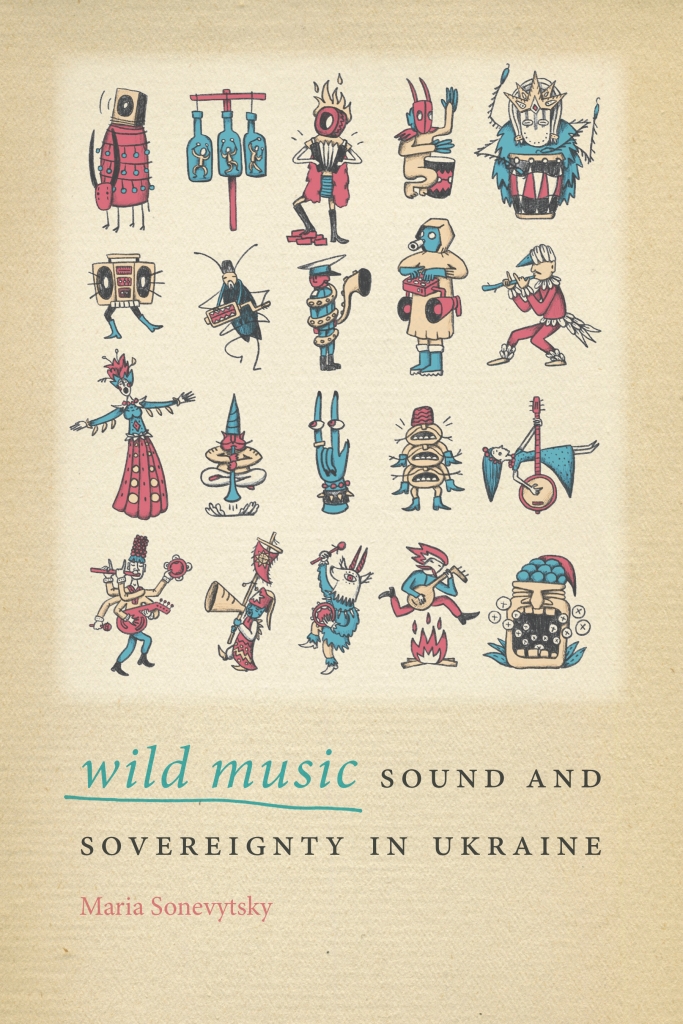
My first book, Wild Music: Sound and Sovereignty in Ukraine, is now out in the Music/Culture Series of Wesleyan University Press!

Cover_WildMusic_FNL

Cover art by Sashko Danylenko

Here is the blurb the press came up with to describe the book:

What are the uses of musical exoticism? In Wild Music, Maria Sonevytsky tracks vernacular Ukrainian discourses of “wildness” as they manifested in popular music during a volatile decade of Ukrainian political history bracketed by two revolutions. From the Eurovision Song Contest to reality TV, from Indigenous radio to the revolution stage, Sonevytsky assesses how these practices exhibit and re-imagine Ukrainian tradition and culture. As the rise of global populism forces us to confront the category of state sovereignty anew, Sonevytsky proposes innovative paradigms for thinking through the creative practices that constitute sovereignty, citizenship, and nationalism.

And here are some kind things some scholars I really admire have to say about the book:

“Sonevytsky’s vivid prose brings together rich ethnography with sophisticated analysis. Through her concept of wildness, she shows how performers disrupt binaries of tradition and modernity, of ‘Eastern’ and ‘Western’ culture, as they construct their country’s sovereignty. A powerful book!”

—Laada Bilaniuk, author of Contested Tongues: Language Politics and Cultural Correction in Ukraine

“Beautifully written, this vital and sensitive ethnography documents the social, affective, and discursive energies that flow within contemporary Ukrainian music. Sonevytsky highlights the possibilities for imaginative agency that “wild musics” provide, without ignoring the very real constraints that hem in the Ukrainian subjects whose complex personhood is the real focus of this remarkable book.”

—J. Martin Daughtry, author of Listening to War: Sound, Music, Trauma, and Survival in Wartime Iraq

“Post-Soviet Ukraine emerges in this beautiful and original book as a place of a vibrant musical and sonic culture. Marked by experiment, hybridity, and ‘wildness,’ this scene not only produces remarkably creative musical projects, but also makes new forms of political sovereignty, citizenship and community imaginable. A great achievement.”

—Alexei Yurchak, author of Everything Was Forever, Until It Was No More: The Last Soviet Generation

It can purchased directly from the press, on Amazon, or even better, from your local academic bookstore!

Ukraine and Decolonial Thought: History, Culture, Political Economy

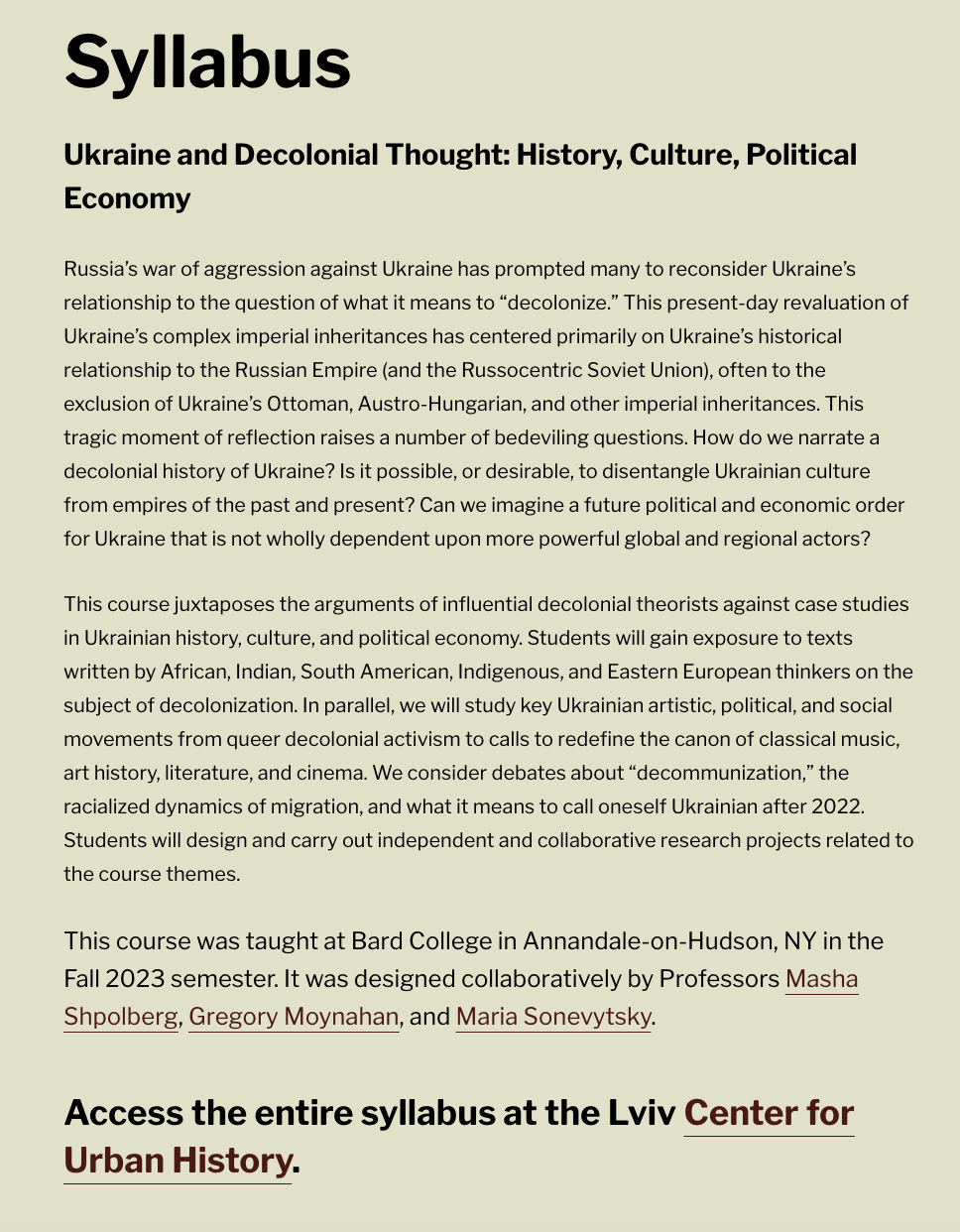
In the fall of 2023, I collaborated with two wonderful Bard colleagues — Profs. Masha Shpolberg and Greg Moynahan — on a new class that set out to explore how various anti- post- and de-colonial theories might help us (or not) explain what is happening in the ongoing Russian war of aggression against Ukraine. For their final projects, students responded to/remixed works by Ukrainian artists while drawing in some of these theoretical concepts. We’ve created a site to house the syllabus (also archived at the Center for Urban History in L’viv) alongside these students works: decolonialukraine.art. We hope this site can be a resource for others.